By
By 
The solar quote sitting on your desk looks compelling. Your salesperson ran the numbers, circled the payback period, and made it feel like a no-brainer.
The problem is that those numbers were built to close a deal, not to survive a board meeting. Most commercial solar projections contain at least three optimistic assumptions that quietly collapse over the life of the system.
This article breaks every one of them down so you can run your own honest numbers before you sign anything.
TL;DR: Commercial Solar ROI
Commercial solar ROI is the ratio of lifetime energy savings to total system cost, including installation, inverter replacement, and degradation losses. Most sales projections assume ideal self-consumption, stable feed-in tariffs, and no panel degradation. Strip those assumptions out, and a quoted 5-year payback can stretch to 8 or 9 years in realistic conditions.
Why the “5-Year Payback” Claim Rarely Survives Contact With Reality

Solar salespeople are not lying. They are building their models with inputs that favour the best-case outcome, because that is how proposals get approved. Understanding which inputs are doing the heavy lifting gives you the leverage to challenge them.
Assumption 1: Your Self-Consumption Rate Is Overstated
Self-consumption rate is the percentage of solar energy your business uses directly rather than exporting to the grid. Exported power earns a feed-in tariff (FiT), which in Australia currently sits between $0.04 and $0.10 per kWh, depending on your retailer and state. The power you actually use yourself offsets the electricity you would have bought at $0.25 to $0.40 per kWh.
A high self-consumption rate means high savings. So salespeople model it highly.
The reality: most commercial buildings have irregular or seasonal load profiles. A warehouse with a single large shift, a retail shop that closes at 6 pm, or any business with weekend shutdowns will export a large portion of midday solar generation. If your quote assumes 80% self-consumption but your actual operation supports 50%, your annual savings can drop by 20 to 30%.
What to do: Pull 12 months of interval data from your electricity retailer (available on request). Plot your half-hourly consumption against solar generation curves for your latitude. If you don’t have access to interval data, a reputable installer should be willing to model it from your meter data. If they won’t, that tells you something.
Assumption 2: Feed-In Tariffs Will Hold
Feed-in tariffs are not guaranteed. They are set by retailers and reviewed regularly. In Australia, FiTs have been falling steadily for a decade. Victoria’s minimum FiT dropped from $0.12/kWh in 2019 to $0.04/kWh by 2024. Several states have moved to time-varying FiTs that pay almost nothing during peak solar hours precisely because the grid is flooded with solar at midday.
A sales model that locks in today’s FiT rate for 10 years is not a financial projection. It is a wish.
Run your numbers assuming your export rate falls by 30 to 50% within five years. If the system still pays back at that rate, it is a resilient investment. If it doesn’t, your ROI depends on regulatory decisions outside your control.
Assumption 3: Panel Output Stays Constant
Solar panels degrade. The industry standard degradation rate is approximately 0.5% per year, based on NREL (National Renewable Energy Laboratory) research across thousands of installed systems. That means a 100kW system producing 140,000kWh in year one will produce roughly 126,700kWh in year 10 and around 119,300kWh by year 15.
Sales quotes apply a flat annual generation figure, but solar panel output degradation through temperature losses, soiling, and inverter inefficiency means a system producing 140,000 kWh in year one will never replicate that number across the life of the array.
Most sales projections use a flat annual generation figure, or apply a token 0.5% degradation that they bury in a footnote. Over a 20-year system life, cumulative degradation reduces total output by roughly 10 to 15% compared to a flat-output model.
That is not catastrophic, but it is real money that does not appear in the headline payback period.
The Costs the Quote Leaves Out

Inverter Replacement
Your solar panels carry a 25-year performance warranty. Your inverter does not. String inverters typically last 10 to 15 years. A commercial-grade string inverter for a 30 to 100kW system costs between $3,000 and $12,000 to replace, including labour, and that cost almost never appears in the initial ROI model.
If your system is financed over 7 years, the inverter replacement hits after your loan is paid but before your system has delivered its projected lifetime savings. Budget for it. Ask your installer to include it in the model. If they push back, add it yourself.
Network Tariff Restructuring
As solar penetration increases, Australian energy networks are restructuring their tariff systems. Demand charges, capacity charges, and time-of-use pricing are becoming more common for commercial accounts. These changes can erode savings even when your panels are performing perfectly, because the value of your offset electricity changes based on when you use it.
A system sized to eliminate a flat-rate electricity bill may deliver significantly less value under a restructured demand tariff. Ask your retailer what tariff changes they have planned and model accordingly.
Ongoing Maintenance
Panel cleaning, system monitoring, and occasional repairs are real costs. Budget approximately $500 to $1,500 per year for a commercial system in the 30 to 100kW range, depending on location and roof access. Dust, bird activity, and leaf debris measurably reduce output. A dirty panel in summer in regional Australia can lose 5 to 15% of daily output.
How the STC Rebate Actually Works (And When It Helps Less Than You Think)
Small-scale Technology Certificates (STCs) reduce your upfront installation cost. The discount is calculated based on your system size, location, and the number of years remaining until the STC scheme ends in 2030. The scheme dials down every year, so a system installed in 2026 generates fewer STCs than the same system installed in 2022.
Most quotes present the STC discount as a fixed dollar figure. What they do not always explain: STC values fluctuate with market demand and are assigned at the time of installation based on remaining scheme years. As 2030 approaches, the discount shrinks. If you are planning a commercial solar installation and delaying the decision to “wait for prices to drop,” the STC reduction may offset any hardware cost savings.
The Difference Between the Quote and the Reality
A 75kW rooftop system for a manufacturing facility in South East Queensland. The original sales quote projected a 3.1-year payback. When Commercial Solar Fit Solutions audited the proposal against actual interval data, the stress-tested model told a different story:
- System cost after STC rebate: $68,000
- Annual savings: $22,000
- Payback period: 3.1 years
After applying realistic assumptions:
| Variable | Sales Quote | Stress-Tested Model |
| Self-consumption rate | 85% | 60% |
| Feed-in tariff (10yr avg) | $0.08/kWh | $0.05/kWh |
| Panel degradation modelled | 0% | 0.5%/year |
| Inverter replacement included | No | $8,500 at year 12 |
| Annual maintenance budget | $0 | $900/year |
| Adjusted annual savings (avg) | $22,000 | $14,800 |
| Adjusted payback period | 3.1 years | 5.8 years |
The system still pays back. It is still a good investment. But 5.8 years is a materially different decision than 3.1 years when you are comparing it to alternative capital uses.
How to Run an Honest Commercial Solar ROI Calculation
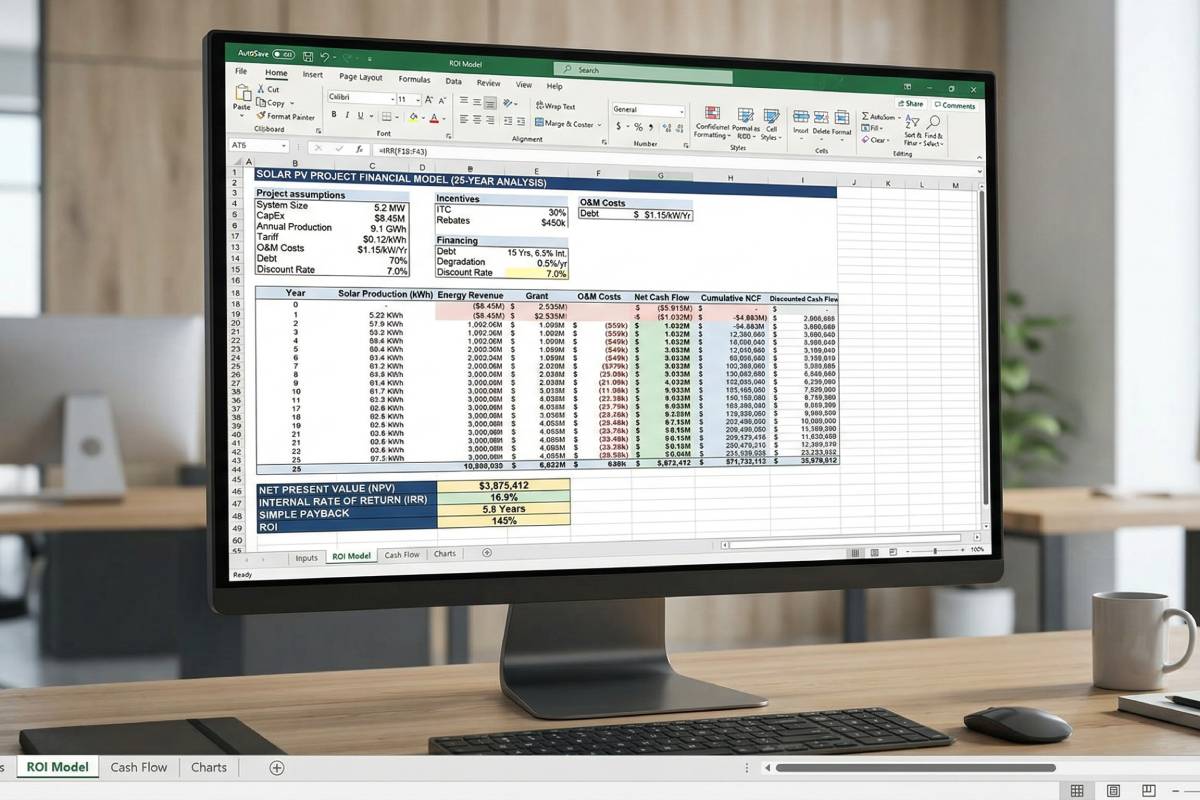
Use this framework before you approve any proposal:
Step 1: Get your actual interval data
Ask your retailer for 12 months of half-hourly consumption data. This is your baseline.
Step 2: Map generation to consumption
Use a tool like PVWatts or ask your installer for a generation profile that matches your roof orientation and tilt. Overlay it against your interval data to calculate realistic self-consumption.
Step 3: Model three FiT scenarios
Current rate 30% lower, and 50% lower. If the ROI is acceptable in the worst case, proceed.
Step 4: Add inverter replacement
Factor in one replacement at year 12. Use a conservative quote from a second installer.
Step 5: Apply 0.5% annual degradation
Run this across the full system life in your financial model.
Step 6: Compare to your cost of capital
If you finance the system at 7% over 7 years, your ROI calculation must beat that hurdle rate net of all costs, not against a zero-cost baseline.
What a Strong Commercial Solar Investment Actually Looks Like
Not every solar proposal is built on wishful thinking. The best investments share specific characteristics:
- High daytime load. Businesses operating Monday to Friday, 8 am to 5 pm, with consistent energy use through the middle of the day. Cold stores, manufacturing, data centres, and commercial kitchens.
- Large roof area relative to load. Enough space to size the system to actual consumption rather than maximum capacity.
- Battery storage where the economics work. Not always, and not at current battery prices for all scenarios, but for businesses with demand charges, a battery that shaves peak demand can change the entire tariff calculation.
- Cash purchase or low-cost finance. Interest costs on solar finance are a real drag on ROI. A $70,000 system financed at 8% over 7 years adds roughly $22,000 in interest before it pays for itself.
Key Takeaways
- Most commercial solar ROI projections use optimistic self-consumption rates, flat FiT assumptions, and no degradation modelling. Correcting these three inputs alone can add 2 to 4 years to the real payback period.
- Inverter replacement and ongoing maintenance are legitimate costs that belong in every ROI model, not just the sales conversation you have to initiate.
- A stress-tested solar investment that still pays back at 6 to 7 years under realistic assumptions is a better business decision than an unexamined 3-year claim.
Discussion question: If you’ve already installed commercial solar, how did your actual first-year savings compare to the original quote? The gap between projected and actual performance is where the most useful data lives.