By
By 
Everyone tells you solar panels “use sunlight to make electricity.” That sentence tells you nothing. If you don’t understand the actual mechanism, you can’t evaluate efficiency ratings, spot a dodgy installation, or know why your system’s output drops on a hazy day. The photovoltaic principle is not complicated once it’s explained correctly. Here’s the full process, from the atom up.
What Is the Photovoltaic Effect?
The photovoltaic effect is the foundational principle behind every solar panel on the market. It was first observed by French physicist Edmond Becquerel in 1839 and describes the ability of certain materials to generate an electric current when exposed to light.
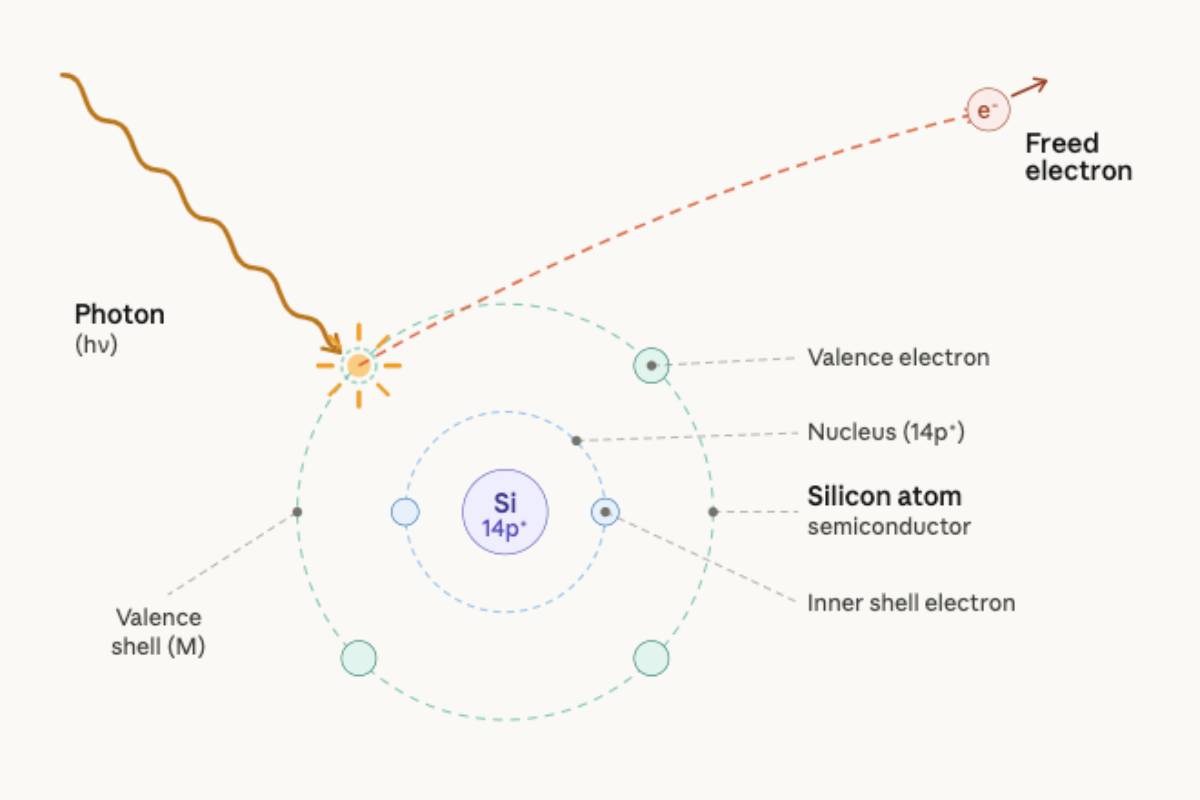
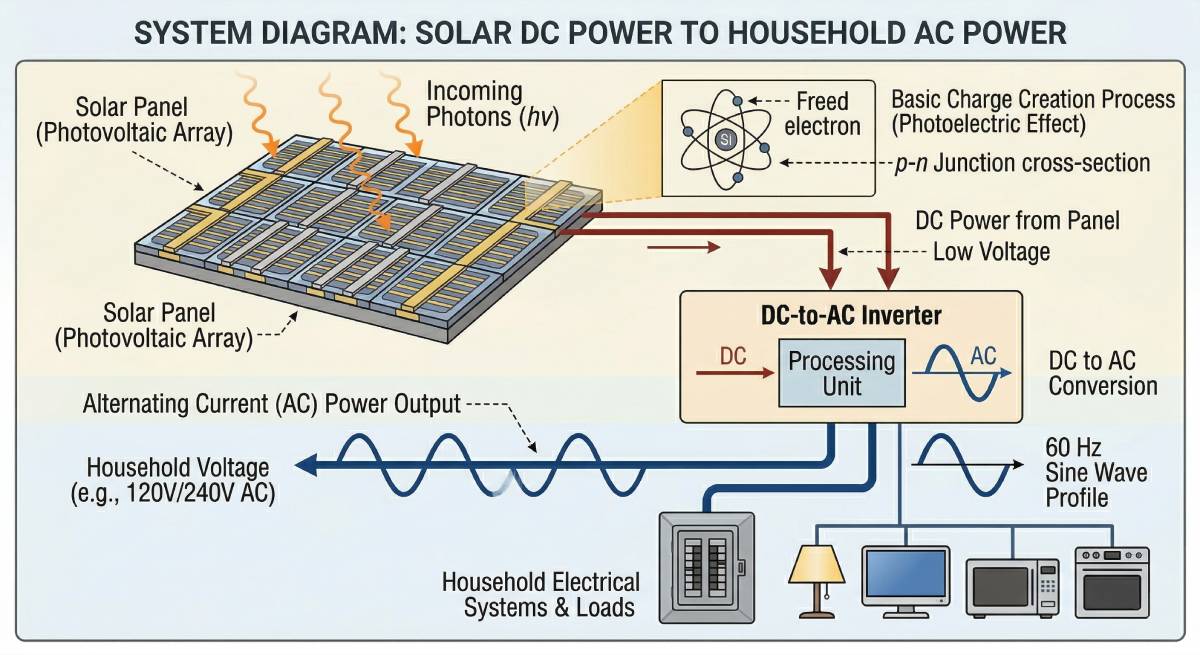
The effect occurs at the subatomic level. Sunlight consists of particles called photons, each carrying a specific amount of energy. When a photon with sufficient energy strikes a semiconductor material, it transfers that energy to an electron, knocking it free from its atom. That liberated electron is the beginning of an electric current.
Without a structure to direct those freed electrons in one consistent direction, you’d have random movement with no useful output. That’s the job of the solar cell’s internal architecture.
Inside a Solar Cell: Silicon, Doping, and the P-N Junction
Silicon is the semiconductor of choice for over 95% of solar panels manufactured today (International Energy Agency, 2023). It’s abundant, stable, and has an atomic structure that responds predictably to photons in the visible and near-infrared spectrum.
Silicon is refined from quartz, one of the most abundant minerals on earth, and Australia’s mining industry, already a global leader in producing lithium and rare earth elements critical to clean energy technology, is increasingly positioned to supply the raw materials feeding solar panel and battery manufacturing at scale.
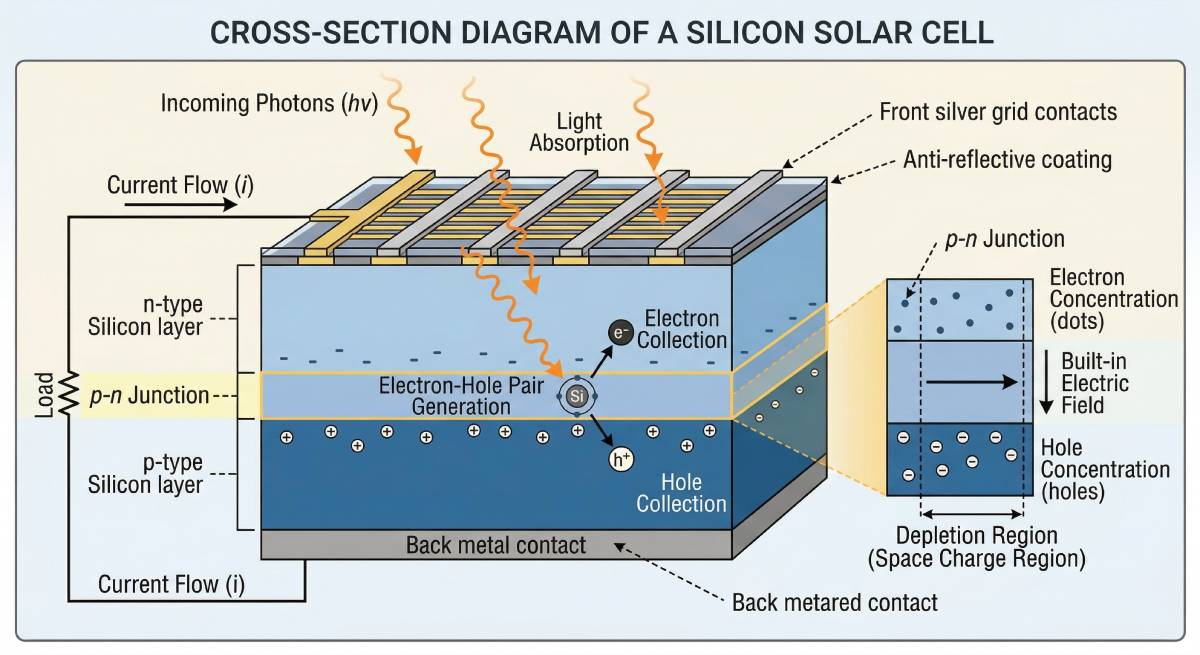
A raw silicon crystal doesn’t conduct electricity efficiently on its own. Manufacturers alter it through a process called doping, introducing trace amounts of other elements to create two distinct layers.
- N-type layer: Doped with phosphorus, which has one extra electron per atom. This layer has an excess of free electrons.
- P-type layer: Doped with boron, which has one fewer electron per atom. This layer has an excess of “holes” (positive charge vacancies).
Where these two layers meet is the p-n junction. This boundary creates a built-in electric field that acts like a one-way gate. When photons free electrons near this junction, the electric field forces them to move in a single direction: electrons toward the n-type side, holes toward the p-type side.
That directed movement is an electric current.
How Electrons Become Usable Electricity
The freed electrons flow through metal contacts printed on the front and back of the cell, forming a circuit. This produces direct current (DC) electricity, meaning electrons flow in one continuous direction.
A single silicon cell generates approximately 0.5 to 0.6 volts of DC electricity under standard test conditions. That’s enough to power nothing useful by itself. So manufacturers wire cells together in series to build a panel, and panels together to build an array.
A standard residential solar panel contains 60 to 72 cells, producing 250 to 400 watts of power under full sun. A typical Australian rooftop system runs between 6.6 kW and 10 kW, requiring 16 to 25 panels depending on their rated output.
From DC to AC: The Role of the Inverter
Every appliance in your home runs on alternating current (AC), where the direction of electron flow reverses 50 times per second (50 Hz in Australia). Solar panels produce DC. These two are incompatible without a conversion step.
The inverter is the device that bridges this gap. It takes the DC output from your panels or battery and converts it into grid-compatible 240V AC power. There are three main inverter types used in residential systems: string inverters (one central unit for the whole array), microinverters (one per panel), and hybrid inverters (which also manage battery storage).
The inverter is also where system monitoring occurs. Most modern inverters log output by the minute, letting you compare generation against expected performance and catch faults early.
The AC output from a solar-connected inverter is compatible with household circuits, standard battery storage systems, and increasingly, with charging setups for electric vehicles in Australia, where home solar charging has become one of the primary financial arguments for EV ownership.
Solar Panel Efficiency: What the Numbers Actually Mean
Efficiency measures the percentage of sunlight hitting the panel surface that converts to electricity. A panel rated at 22% efficiency converts 22% of incoming solar energy into electrical output; the remaining 78% is lost, primarily as heat.
This is where most informational articles go shallow. Efficiency is not just a single number. It is affected by:
- Cell technology (monocrystalline outperforms polycrystalline in low-light conditions)
- Temperature (output drops approximately 0.3 to 0.5% for every 1°C above 25°C)
- Shading (partial shade on one cell in a string can reduce output for the entire string, not just that cell)
- Soiling (dust accumulation on a panel surface can reduce output by 5 to 25%, depending on location and cleaning frequency, per CSIRO research on Australian conditions)
The efficiency number on the spec sheet is measured under Standard Test Conditions (STC): 1,000 W/m² irradiance, 25°C cell temperature, and a specific air mass coefficient. Real-world conditions deviate from STC constantly.
Solar Cell Types: A Direct Comparison
| Cell Type | Efficiency Range | Temperature Coefficient | Cost (Relative) | Best Use Case |
| Monocrystalline | 20–23% | –0.30 to –0.35%/°C | High | Limited roof space, high-output goals |
| Polycrystalline | 15–18% | –0.40 to –0.45%/°C | Medium | Budget installs, large roof areas |
| Thin-Film (CdTe/CIGS) | 10–13% | –0.20 to –0.25%/°C | Low | Commercial, curved surfaces |
| Bifacial Mono | 21–24%+ | –0.30%/°C | High | Ground-mount, reflective surfaces |
| TOPCon / HJT | 22–25% | –0.25 to –0.29%/°C | Premium | Maximum performance per m² |
TOPCon (Tunnel Oxide Passivated Contact) and Heterojunction Technology (HJT) panels represent the current commercial frontier. Several Australian installers began stocking HJT panels in volume by 2024, with real-world output data now validating the lower temperature coefficient advantage in Queensland and NT climates.
Why Output Varies: A Real-World Scenario
Consider a 6.6 kW system in Perth, one of the world’s sunniest capital cities with approximately 8.8 peak sun hours per day in summer. On paper, that system should produce 58 kWh daily (6.6 kW x 8.8 hours).
In practice, the same system produces closer to 28 to 32 kWh per day on average across the year after accounting for inverter losses (typically 3 to 5%), soiling, temperature derating on hot afternoons, and cable losses. The gap between nameplate capacity and real output is not a flaw. It’s the predictable result of applying lab conditions to a real roof.
Understanding the photovoltaic principle lets you interrogate these numbers. If your system produces 40% below expected output on a clear day, you’re not looking at a panel problem. You’re most likely looking at shading, a failing inverter, or a wiring fault. The principle tells you where to look.
Wrap-Up
- Solar panels generate electricity through the photovoltaic effect: photons free electrons in silicon semiconductor cells, and the built-in electric field at the p-n junction drives those electrons in one direction to create DC current.
- A solar cell produces roughly 0.5V per cell; panels connect cells in series to reach useful voltages, and an inverter converts DC to household-compatible AC.
- Real-world output is always lower than nameplate capacity due to temperature, soiling, shading, and inverter losses. Knowing the underlying principle is what lets you distinguish a normal variance from a system fault.
Discussion question: Given that temperature reduces panel output and Australia’s climate regularly pushes rooftop temperatures above 60°C in summer, do you think efficiency ratings tested at 25°C are misleading consumers, or is the gap small enough to be irrelevant in a purchasing decision?