By
By 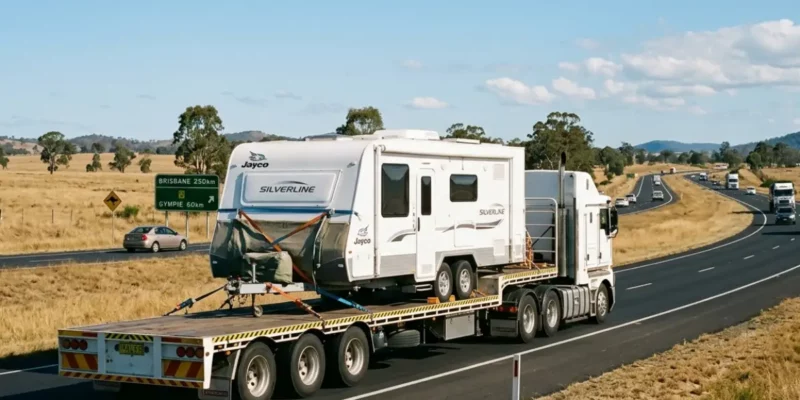
You have bought a caravan in another state, or you are relocating and cannot tow it yourself. The first question is always the same: what will it actually cost to move it across the country?
Prices vary widely, and a vague quote helps nobody. This guide breaks down the real cost ranges, the factors that move the price up or down, and whether towing it yourself is the cheaper option once you add everything up.
By the end, you will know what a fair quote looks like and how to avoid paying more than you need to.
Table of Contents
- The price range you can expect
- Example costs on common routes
- What drives the cost up or down
- Towing it yourself vs paying a transporter
- Transport service types compared
- How to choose a transporter
- Mistakes that inflate your bill
- How to lower your quote
- Common questions
The price range you can expect
Interstate caravan transport in Australia is usually priced per kilometre, with most routes falling between $1.50 and $3.50 per km for a standard single-axle to tandem caravan.
A Sydney to Brisbane move (roughly 920 km) commonly lands between $1,400 and $3,000. A longer haul, such as Melbourne to Perth (about 3,400 km), can sit anywhere from $5,000 to over $10,000.
The widespread is normal. The same route can vary by thousands of dollars depending on the size of your van and the service level you choose.
One reason per-km rates fall on longer trips is fixed cost spreading. The transporter pays for loading time, fuel to position the truck, and administration regardless of distance, so a 3,000 km haul often works out cheaper per kilometre than a 600 km one.
Demand for these services keeps climbing. According to Tourism Research Australia, there were almost 938,000 caravans and campervans registered nationally in 2025, a 32 per cent increase since 2019. More vans on the road means more owners needing them moved between states.
Example costs on common routes
Seeing real routes makes the per-km rate easier to apply to your own move. The figures below assume a standard road-ready single or tandem-axle van towed by the transporter, not a float.
| Route | Approx distance | Typical price range |
| Sydney to Brisbane | 920 km | $1,400 to $3,000 |
| Melbourne to Sydney | 880 km | $1,400 to $2,800 |
| Brisbane to Cairns | 1,700 km | $2,500 to $5,000 |
| Adelaide to Perth | 2,700 km | $4,000 to $8,500 |
| Melbourne to Perth | 3,400 km | $5,000 to $10,000+ |
Treat these as a sanity check, not a fixed quote. A van that needs a float, a regional pickup, or an urgent date will sit at the top of each range or above it.
If a quote comes in far below the bottom of the range, ask what it excludes. Cheap headline numbers often leave out insurance, depot handling, or a fuel levy that appears later.
What drives the cost up or down
Distance is the headline number, but several other factors decide where you land in the range.
Size and weight
A compact pop-top costs less to move than a 22-foot tandem-axle van. Larger vans need bigger prime movers and take up more space on a multi-load trailer, so the rate per km rises.
Route and remoteness
Capital-city-to-capital-city routes are the cheapest because transporters run them constantly. Pickups or drop-offs in remote areas add cost, since the driver may travel empty for part of the trip.
Drivable vs non-drivable condition
If your van rolls and has working brakes and lights, it can be towed behind a vehicle, which is the cheaper method. A van that cannot be towed safely needs a flatbed or float, which costs more.
Timing and flexibility
Flexible pickup windows let a company slot your van into an existing run. Fixed dates and urgent jobs attract a premium.
Backloading availability
Transporters running a route in one direction often have spare capacity on the return leg. Catching a backload can cut the price sharply, but it ties you to the company’s schedule rather than yours.
| Cost factor | Lower cost | Higher cost |
| Van size | Pop-top or single axle | Large tandem axle |
| Route | Capital to capital | Remote or regional |
| Condition | Towable, road-ready | Non-drivable, needs float |
| Timing | Flexible dates | Urgent or fixed date |
Towing it yourself vs paying a transporter
On paper, towing your own van looks free. Once you total the real costs, the gap narrows fast.
For a one-way interstate trip, you need to factor in fuel for a heavily loaded tow vehicle, which burns far more than usual, plus accommodation, meals, and the value of several days off work. A long haul can mean a week on the road each way.
There is also wear on your vehicle and the risk that comes with towing a large van on unfamiliar long-distance routes. For owners who are not confident reversing or handling a van in crosswinds, a professional service removes that pressure entirely.
If you decide the time and stress are not worth it, a specialist provider such as Interstate Caravan Transport handles the pickup, the long-distance leg, and delivery so your van arrives without you logging a single kilometre. Weighing that convenience against the fuel and days off is the real comparison most owners need to make.
Transport service types compared
Not every job needs the same service, and matching the type to your van keeps the price sensible.
Towed transport
The driver hitches your road-ready van and tows it to the destination. This is the most economical option for vans in good working order.
Flatbed or float transport
The van is loaded onto a trailer. This suits non-drivable vans, vintage vans, or owners who want zero kilometres added to their van.
Door to door vs depot to depot
Door-to-door collects and delivers at your address for maximum convenience. Depot to depot is cheaper but requires you to drop off and collect from the company’s yards.
How to choose a transporter
Price is only one part of the decision. A cheap quote from a poorly insured operator can cost far more if your van arrives damaged.
Check that the company carries marine transit or goods-in-transit insurance and ask for the cover limit in writing. Confirm they have an Australian Business Number and look for reviews that mention condition reports and on-time delivery, not just price.
Ask whether they complete a written condition report with photos at pickup. This protects both sides if a dispute arises over a scratch or dent on arrival.
Be wary of operators who only take cash, refuse to put insurance details in writing, or quote far below everyone else. A realistic quote from an insured carrier is worth more than the lowest number on the page.
Mistakes that inflate your bill
Several avoidable errors push the final figure higher than it needs to be.
Leaving the van loaded with gear adds weight and can trigger a surcharge or a refusal to collect. Booking at the last minute removes any chance of a backload discount and forces an urgent rate.
Giving vague pickup details also costs money. If the driver cannot access your address with a long rig, you may pay for a re-route or a shuttle to a more accessible point.
Skipping the insurance question is the most expensive mistake of all. A thin policy can leave you covering repairs yourself if the van is damaged in transit.
How to lower your quote
A few simple moves can shave a meaningful amount off the final figure.
Stay flexible on dates so the company can add your van to an existing route. Choose depot pickup and delivery if you live near their yards. Make sure the van is clean, empty of loose items, and road-ready to avoid surcharges.
Always request at least three written quotes and confirm what insurance is included, because the cheapest number is not a saving if the cover is thin.
Conclusion
Interstate caravan transport costs come down to distance, van size, condition, and how flexible you can be on timing. Knowing the per-km range and the cost drivers means you can read any quote with confidence and pick the option that genuinely suits your budget.
Want more practical guides for life on the road? Read our related piece on safely loading heavy gear onto a trailer before you book.
Common questions
Is my caravan insured during transport?
Reputable companies carry transit insurance, but cover limits differ. Ask for the policy details in writing and check whether your own contents insurance extends to transit.
How long does interstate transport take?
Short hauls between neighbouring capitals are often completed within a few days. Cross-country routes can take one to two weeks, depending on scheduling and the company’s run.
Should I empty the caravan first?
Yes. Remove loose items, secure cupboards, and turn off the gas. Loose contents can shift and cause damage, and some companies will not accept a loaded van.
Do I need to be present at pickup and delivery?
For door-to-door service, you or a nominated person should be present to sign the condition report at both ends. If you cannot attend, arrange for someone to inspect the van and photograph it before the driver leaves.
What happens if my caravan is damaged in transit?
Compare the arrival condition report against the pickup one and photograph any new damage immediately. Lodge a claim with the transporter’s insurer in writing, citing the dated condition reports. This is why an operator who documents the condition at pickup is worth choosing.
Can I transport a caravan that is not registered?
A van towed on the road generally needs current registration. An unregistered van usually has to travel on a float or trailer instead, which costs more, so confirm your registration status before requesting quotes.